Overview
Abstract
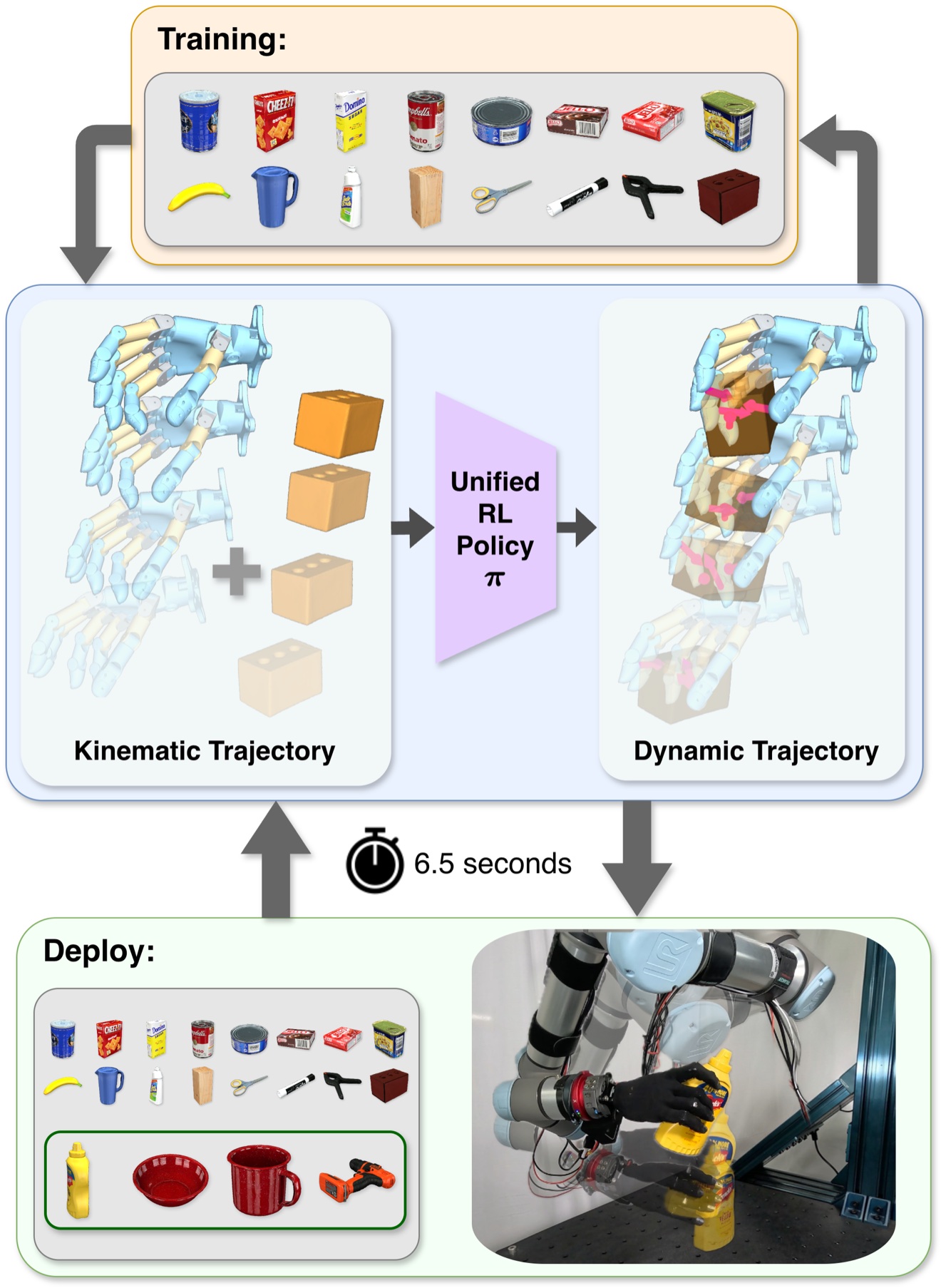
Retargeting human demonstrations into dynamically feasible dexterous hand trajectories requires resolving complex contact physics, yet current methods either omit physical constraints or rely on computationally expensive sampling-based optimization in simulation. Reinforcement learning has previously been used to achieve planning and control through contact dynamics; however, standard policies require object-specific training and fail to generalize across arbitrary geometries. This work reframes physics-based retargeting as a residual learning problem, where we demonstrate that zero-shot generalization across objects relies on structured state representations. Specifically, formulating the observation space to include a localized contact-error signal guiding each robot link to its target coordinate on the object surface enables a single, unified residual policy to successfully grasp novel, unseen object geometries. Rolling out this policy in simulation on a kinematic reference trajectory yields a physics-based retargeter, OATH. Operating at 0.4 seconds of compute per second of reference, OATH achieves 2.4× faster-than-real-time performance and a 60–350× reduction in computational cost compared to sampling-based methods. The system recovers 58% of held-out and 54% of unseen-object DexYCB trajectories while maintaining a sub-2 cm tracking error.
Method
Where the kinematic trajectory comes from
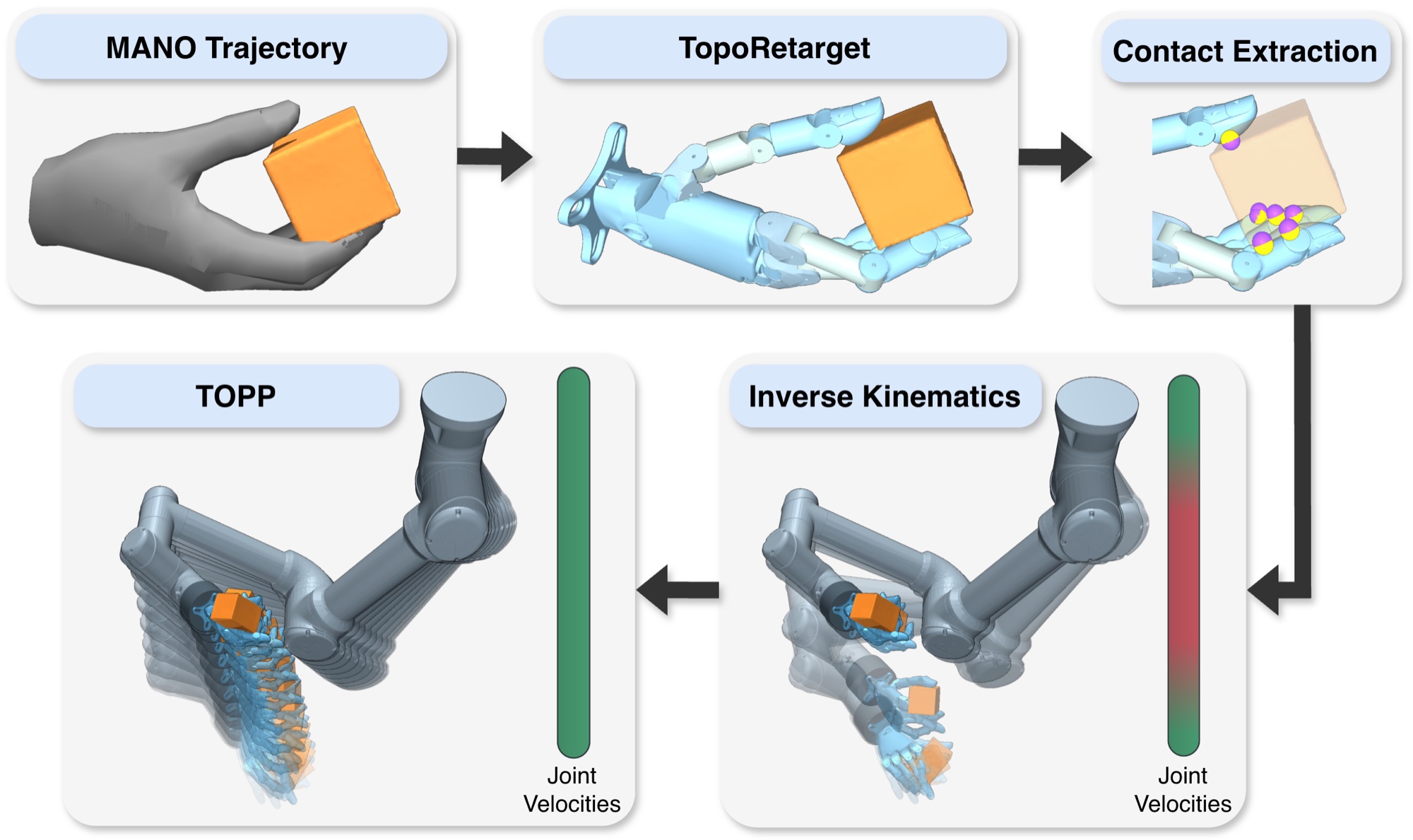
The output of the retargeting pipeline is , containing the robot and object states and , contact presence , and contact locations in the object and robot body frames , .
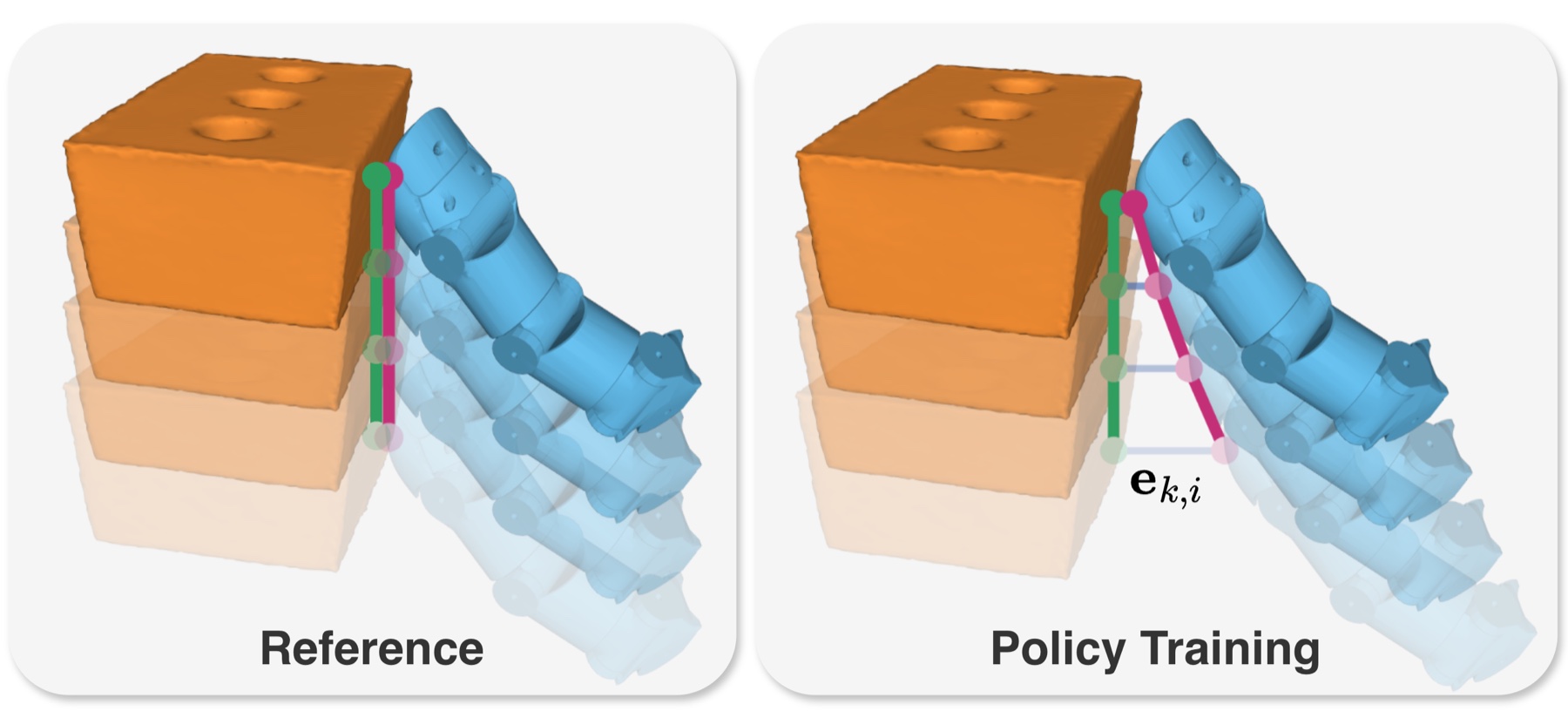
The key: contact-error observations
Everything the policy receives. Hover a term for its meaning.
↓ The contact error , up close
Results
Simulation
Against the baselines
| Baselines | OATH | ||||||
|---|---|---|---|---|---|---|---|
| SPIDER [1] | DAID [2] | ReGrind [3] | CHORD [4] | Train | Test | Unseen | |
| ↑Success (%) | 22.0 | 100 | 5.4 | 2.0 | 90 | 58 | 54 |
| ↓Tracking error (mm) | 29.9 | 20.4 | 43.2 | 7.9 | 11.7 | 15.3 | 13.8 |
| ↓Compute per second | 25.2 | 138 | 0.93 | 0.88 | 0.40 | ||
| ↓Compute per success | 124 | 138 | 15.8 | 64.9 | 0.46 | 0.69 | 0.71 |
Compute in seconds per second of reference, normalised to an RTX 5080. Bold is best in each row.
Hardware, open loop
BibTeX
@article{sigurdson2026oath,
  title   = {{OATH}: Object-Agnostic Tracking for Dexterous Hands,
             Enabling Rapid Physics-based Retargeting},
  author  = {Sigurdson, Solvin and Sriganesh, Prasanna and Borbon, Juan and
             Burdick, Joel and Zhang, Dingqi and Wang, Jiuguang},
  journal = {arXiv preprint arXiv:2610.14379},
  year    = {2026}
}
- [1]C. Pan et al., SPIDER: Scalable physics-informed dexterous retargeting, 2026.
- [2]B. Paliwal et al., Do as I do: Dexterous manipulation data from everyday human videos, arXiv:2606.19333, 2026.
- [3]Y. Feng et al., A minimalist retargeting-guided reinforcement learning recipe for dexterous manipulation, arXiv:2607.11874, 2026.
- [4]X. Zhu et al., Learning dexterous manipulation using contact wrench guidance from human demonstration, arXiv:2607.00033, 2026.
- [5]J. Wu et al., TopoRetarget: Interaction-preserving retargeting for dexterous manipulation, arXiv:2606.16272, 2026.
- [6]H. Pham and Q.-C. Pham, A new approach to time-optimal path parameterization based on reachability analysis, IEEE T-RO, vol. 34, no. 3, pp. 645–659, 2018.
- [7]Y.-W. Chao et al., DexYCB: A benchmark for capturing hand grasping of objects, CVPR, 2021.